Stellar Unbound: A Millennium of Humanity’s Stellar Journey (Working Title)
This chronicle spans a thousand years of human endeavour (2024-3024), tracing humanity’s expansion from Earth to the stars, a journey profoundly shaped by technological breakthroughs, societal upheavals, and the enduring philosophical questions of existence and perception. The narrative is set against the backdrop of the Overall Communication Network (OCN), which evolved from the early pioneering company StellarLink, and its headquarters on Nova Arcis, a major Kuiper Belt station. A central theme is Amara Varna’s philosophy of Perceptionism, which explores how collective narratives and interpretations of events shape reality, often diverging from objective truth.
1. The [EARTH] Period (Pre-2024 – 2090): The Spark of ITT and Planetary Upheaval The human journey to the stars was built upon the aspirational dreams of early space pioneers like Tsiolkovsky and the foundational work of institutions such as JPL, involving figures like Frank Malina. The true catalyst for interstellar expansion, however, arrived in 2024 when Amara Varna, a self-taught physicist and artist in Mumbai, invented Instantaneous Translocation Technology (ITT). Initially termed Inverse Time Travel, ITT was born from Varna’s revolutionary reconceptualization of spacetime into “time-space,” an inversion she theorized allowed for near-instantaneous relocation.
The immense potential of ITT was quickly recognized by Darius Voss, a young, ambitious entrepreneur who founded StellarLink. Through shrewd negotiations and a deep, though often publicly misperceived, friendship with Amara Varna, Voss secured the initial ITT patents. StellarLink rapidly deployed a global OCN (Orbital Connections Network) of 52 ITT hubs in major cities like Hamburg, Mumbai, and Maputo, fundamentally transforming global logistics, trade, and travel.
This technological leap was not without significant consequences. The “Airpocalypse” by 2039 saw the collapse of the traditional air travel industry, as detailed in “The Last Flight of the Bros. Wright.” While ITT promised unprecedented efficiency, its initial energy demands (approximately 27 liters of gasoline equivalent per ton) and reliance on existing power grids sparked considerable environmental debate and accusations of corporate greenwashing directed at StellarLink.
Simultaneously, Earth faced a deepening climate crisis. By the late 21st century, rising sea levels and extreme weather patterns were drastically reshaping the planet, leading to mass migrations and the formation of new socio-political entities, such as the United Earth Accord (UEA) by 2250. Various social factions, including the “Desillusionados,” “Ignorantes,” and “Naturephantastics,” emerged, reflecting the societal turmoil and differing responses to the planetary challenges.
Amidst this era of change, Mego Reveers, the charismatic and egomaniacal founder of Ares Dynamics, championed an alternative path: the colonization of Mars using conventional rocketry and fossil fuels, publicly dismissing ITT. His Earth-based “Spacecity” was conceived as a rigid, hierarchical model for his Martian ambitions, inadvertently sowing the seeds for future conflict. The “Varma Leak” in 2050, which brought Amara Varna’s journals and her concerns about spacetime strain from excessive ITT use to public attention, alongside her critiques of corporate exploitation, further fueled public debate. This leak also solidified the public’s misperception of her relationship with Darius Voss as purely adversarial—a narrative carefully constructed by corporate interests. Amara Varna herself would later attempt to correct this, emphasizing their enduring friendship and clarifying that her criticisms were aimed at unchecked corporate greed rather than Voss personally.
Despite these challenges, technological progress continued. In 2080, the experimental ITT-assisted ship, “Stellar Explorer,” achieved a sustained speed of 0.01c. This milestone was hailed by the public as a panacea for Earth’s mounting problems and a crucial step towards rapid interstellar travel. Amara Varna, however, offered a more circumspect perspective, highlighting the inherent complexities of time-space and warning against the dangers of overly simplistic narratives—a core tenet of her developing philosophy of Perceptionism.
2. The [MARS] & [STAGNATION] Period (2090 – 2290): Martian Revolution, Asterion Collective, and the Speed Plateau The Martian colonial dream, as pursued by Mego Reveers and his successors at Ares Dynamics, including Odina Rook Reveers and later Jason Rook, devolved into an oppressive two-class system. This societal structure, built on inequality and exploitation, inevitably led to the Martian Revolution, a protracted and violent struggle for liberation that culminated around 2163-2164.
Key events such as the “Red Strike” in 2155, though brutally suppressed by Ares Dynamics, galvanized the Martian workers and fuelled the revolutionary spirit. Figures like Rahul Mehta emerged as prominent leaders of the rebellion. The eventual collapse of Ares Dynamics’ iron grip on Mars triggered a significant exodus, with many Martian refugees, inspired by Mehta’s vision of a society “beyond greed,” seeking sanctuary and a new beginning in the Asteroid Belt.
There, these refugees founded the Asterion Collective. The philosophical and economic framework for this new society, the Asterion Collective Paradigm, was significantly shaped by Hernando “Rooky” Hermanson Rook, a dissident scion of the same Rook family deeply entangled with Ares Dynamics’ Martian regime. This paradigm introduced the Credit/Grant system, a decentralized economic model based on declared output and universal basic access to essentials, representing a fundamental departure from Earth’s old speculative economies.
Ares Dynamics, crippled by the loss of its Martian holdings, made desperate attempts to seize control of the Asteroid Belt’s resources. These aggressive efforts were met with fierce and organized resistance from the Asterion Collective. A notable act of defiance was the “Great Network Blackout” in 2185, during which the Collective demonstrated its technological capabilities by disrupting Martian ITT networks. Ares Dynamics, overextended and outmanoeuvred, ultimately filed for bankruptcy in 2190.
Throughout this period of upheaval and societal restructuring, human presence continued to expand across the solar system. Vignettes from “Day in the Life” offer glimpses into the varied existences of individuals such as Emanuela Kantor, an estate agent on Europa in 2210, Jeff Nezob on Uranus’s Oberon Station in 2278, and the shipwright Carlos López on Charon Dock Station in 2290. However, despite these expansions, for nearly two centuries, ITT-driven speeds remained largely stagnant, hovering around the 0.01c+ mark, an era subsequently known as the “Stagnation of Speed.”
3. The [SPEED] Period (2290 – 2400): The “Seeds Of Light” – Breaking the FTL Barrier The “Stagnation of Speed” was decisively broken around 2290 with the invention of ITT-buffering. This crucial technological leap marked the dawn of “The Seeds Of Light” era, dramatically increasing achievable sub-light velocities. Within a few decades, ITT-driven speeds climbed from 0.03c to 0.1c (a milestone achieved by the X-ship “Horizon Vanguard” in 2301), and subsequently to 0.3c and 0.5c becoming the standard for solar system travel. This “speed revolution” forced existing entities, like the ship-families operating interplanetary freighters, to rapidly adapt their vessels and business models.
This era also saw the founding of vital outer solar system hubs: Nova Arcis in the Kuiper Belt in 2305, and Oort Cloud Main Station approximately 30 years later. However, the relentless pursuit of ever-greater speeds was fraught with peril. The “Lightbridge Prototype Incident” in 2369 was a stark reminder of these dangers. An experimental X-ship, built by the Jade-Horizon-Energy corporation, was nearly destroyed while attempting to reach 0.99c. This disaster underscored the profound challenges of near-light travel and the inherent limitations of the existing ITT-buffering technology.
The Lightbridge incident served as a critical catalyst for Dr. Elara Kovacycy. Born on Europa to Earth refugees and a profound scholar of the Varna-Papers (Amara Varna’s extensive collection of research and philosophy), Kovacycy dedicated herself to solving the fundamental “dilation paradox” that barred stable faster-than-light travel. By 2376, she formulated a ground-breaking solution, redefining the theoretical Einstein-Epstein-Bridge into the “Einstein-Varna-Drag” theory. Her work, which controversially incorporated concepts of “negative time” and “negative space” as an oppositional force leading to positive relocation within time-space, paved the way for stable FTL travel.
Even before Kovacycy’s FTL breakthrough was widely implemented, humanity’s gaze was firmly fixed on the stars. Between 2375 and 2381, three sub-FTL colony ships – the “Amara Homework,” “Varna Homestead,” and “Elara Homeland” (the latter renamed from “Venice Homeland” in a tribute to Kovacycy’s achievement) – departed from Oort Cloud Main Station on a daunting 15-year journey to Proxima Centauri. The journalist Gensher Kissinger chronicled the dreams, hopes, and anxieties of these pioneering interstellar settlers.
In 2389, the X-ship “Chop Hop Voyager,” equipped with Dr. Kovacycy’s revolutionary FTL drive, embarked on the first crewed faster-than-light test flight to Proxima Centauri, achieving a speed of 1.03c. Its triumphant return to Nova Arcis in 2398, carrying pilot Geen Grissom and his crew, brought back not only invaluable scientific data but also personal messages from the Proxima settlers, igniting the dream of an FTL news network and instantaneous interstellar communication.
To foster a sense of unity and shared purpose amidst these rapid technological advancements and the dawn of the interstellar age, OCN broadcast “World War X” (2380-2390). This decade-long interplanetary academic and societal quiz competition, utilizing AI adjudicators, emphasized the theme of “Unity Through Competition,” aiming to bind the increasingly dispersed human settlements.
4. The [COLONY] Period (2400 – 2700): Interstellar Colonization and Galactic Society Takes Shape The 25th century witnessed the true dawn of interstellar colonization. Proxima Centauri b, affectionately nicknamed “Amara” by its pioneering settlers in honour of Amara Varna, became humanity’s first habitable extrasolar home. Journalist Gensher Kissinger’s later dispatches in “Dust and Dreams on Proxima B” paint a vivid picture of life on this new world, detailing its unique fungai-based biosphere, the formidable challenges of adapting Martian terraforming techniques, and the establishment of Varna-Station in orbit around the planet.
Other Inner Stars soon followed. Barnard’s Star, initially developed as a montane industrial tech-settlement due to its resource-rich asteroid belt, transformed into the primary colonization hub for expeditions heading to the OuterRim (located North of Sol in galactic terms) and the Rim (East of Sol). The Wolf-Pack systems (Wolf 359, Lalande 21185, Ross 128, and later Procyon and Luyten’s Star), primarily settled through Afro-Chinese initiatives, emerged as a distinct socio-political faction controlling expansion paths South-West of Sol.
FTL speeds stabilized during this period, with ships routinely achieving 4-7c. Various classes of interstellar ships, from agile family-run vessels to massive colony transporters, plied the newly charted star-lanes, connecting the burgeoning colonies. OCN, which had relocated its headquarters to Nova Arcis in 2601, played a crucial role in managing the flow of time-delayed information across these vast distances. It utilized FTL couriers and scheduled data dumps, subtly shaping galactic narratives through the philosophical lens of Amara Varna’s Perceptionism – consciously moderating, maintaining, and mitigating information to foster cohesion and shared understanding in a temporally fragmented galaxy.
Artificial Intelligence continued its ascent and diversification. From early silicon-based systems, AI evolved into complex bio-robotic and hybrid forms. Around 2775, Pope Julius the 24/7th, a distributed multi-stellar AI residing in “black box” installations and offering asynchronous spiritual guidance, became a significant and respected presence across the settled galaxy, demonstrating AI’s expanding role in human society.
5. The [HYPER] Period (2700 – 2900): Hyperspace, Conflict, and Regulation The relentless drive for expansion pushed humanity further into the galaxy, with massive settlement movements targeting stars beyond the 60 light-year frontier. This era of rapid, often reckless, expansion was marred by the Hyperspace Wars (2805-2838). These were not traditional military conflicts between nation-states or colonies, but rather a chaotic period characterized by piracy, corporate espionage, and dangerous, unsanctioned attempts to exceed the practical 7c FTL speed limit, chasing the theoretical 13c hyperspace barrier.
The “Kuiper Belt Massacre” in 2821 served as a horrifying example of these dangers. The “Rush Faction’s” ill-fated attempt to achieve speeds greater than 13c using complex gravity-assisted manoeuvres near Pluto resulted in a catastrophic fleet disintegration, claiming thousands of lives and underscoring the inadequacy of existing regulations and the perilous nature of unchecked ambition.
In response to the escalating risks and the growing instability, the United Earth Accord (UEA) government issued the “Hyperspace Memorandum” in 2794. This controversial policy saw Earth-associated entities formally abandon fast FTL travel (>3c) and revive slower, more conventional “sleeper ship” concepts for essential long-haul interstellar journeys, marking a period of deliberate technological regression for some parts of human space.
The resolution to the destructive Hyperspace Wars came through intensive diplomatic efforts and institutional innovation. Following the “Hyperspace Conferences,” the “Hyperspace Protocols” were ratified, establishing much-needed safety standards and operational guidelines for FTL travel. Crucially, in 2843, the High Yard Academies of Philosophical Honour were founded on the dwarf-planet “Dawn Of The Aquarius” in the GJ 1289 system. Emerging from initiatives like the Nobel Varna Prize, the High Yards, with their various academic departments (including philosophy, natural sciences, arts, and eco-nomics/logics) and the investigative/judicial “Scots Yard,” became the primary interstellar body for mediating disputes, preserving knowledge, and upholding ethical standards in scientific and societal development. Artificial Intelligences were permitted “temporal association” with the Academies, acknowledging their growing intellectual role.
It was also during this tumultuous period, between 2700 and 2800, that a daring and perilous venture set forth: the “Lost Colonies.” Seven ships, attempting sustained 10c travel – a speed considered highly experimental and dangerous – embarked on an isolated journey towards systems approximately 150 light-years South of Sol. Two ships were lost en route, a stark testament to the extreme risks involved. For centuries thereafter, the fate of these intrepid settlers would remain an enduring mystery, a silent question mark on the expanding map of human space.
In around 2830 the mysteries of the galaxy continued to unfold. Journalist Miss Luck Good, working on Teagarden’s Star, later uncovered a criminal network that was exploiting 80-year-old, heavily distorted transmissions originating from the direction of the Lost Colonies. Her investigation, detailed in “News, No Chance Ms Good, Luck,” confirmed their survival in deep isolation, though their exact societal state and technological capabilities remained unknown.
6. The [FUTURE] Period (2900 – 3024/3025): Quantum Leaps and Existential Questions The dawn of the 30th century was heralded by a communications revolution that would once again reshape interstellar society. In 2976, OCN, leveraging the advanced Quantum-IAI developed by its subsidiary AI.tec (likely based on breakthroughs in Quantum-Neuro-Computation), unveiled Instantaneous Quantum-Displaced Communications. This transformative technology shattered the tyranny of light-speed delay for information transfer within norm-space, ushering in an era of real-time galactic connectivity.
This new era of instant connection brought its own profound revelations and challenges. The “Alien Years” of 2916-2917 were particularly momentous. An object initially identified as an alien artifact near Proxima Centauri was revealed to be the ancient Earth probe, Voyager 1 or 2 – a poignant reminder of humanity’s humble beginnings. Far more significantly, a 160,000-year-old alien transmission was detected by a High Yard science outpost, The Chop Hop Gaze. Xeno-linguist Miss Luck Good the Third and her team deciphered parts of this ancient message, which contained ominous warnings such as “Do not exceed the threshold” and the haunting query, “Are you still there?” Amara Varna’s philosophy of Perceptionism proved instrumental in interpreting these ancient echoes, suggesting that other civilizations might have faced similar existential challenges related to technological advancement or the manipulation of collective narratives.
Philosophical debates, often initiated or guided by the High Yards Academies, intensified as humanity grappled with its place in a seemingly ancient and potentially perilous cosmos. From 3014 onwards, a new crisis began to brew, involving growing tensions and imbalances between the established Inner Stars, the now settled Outer Stars -Rim, OuterRim and WolfPack-, and the expansive, far-flung, often resource-hungry and innovative Outskirts.
By 3024, the Hyperspace Memorandum is a distant historical footnote. Earth’s direct political influence is largely confined to the inner solar system, while hubs like Nova Arcis thrive as independent centres of technology, culture, and commerce. Advanced Quantum-IAI is integral to galactic society, and some AI-robots have achieved “full-rights-embodiments,” recognized as citizens with legal standing in progressive entities like the Nova Arcis conglomerate.
The narrative culminates around this time, the dawn of 3025 by the old Earth calendar. Humanity stands as a multi-stellar species, forever changed by its thousand-year journey. The OCN commemorates this millennium of ITT, and the official introduction of GBB (Gong-Bell-Beep) Universal Timing – a new temporal standard based on Proxima Centauri’s orbital mechanics – aims to provide a common measure for an increasingly diverse and widespread civilization. As humanity faces new horizons, the enduring questions of purpose, perception, and survival continue to propel it forward. The Varna-Papers, Amara Varna’s vast and largely unread collection of research, philosophy, and art, continue to be explored, hinting at deeper understandings of the universe and humanity’s potential within it – a guiding light, perhaps, for the millennium yet to come, as humanity continues its journey into the “Stellar Unbound”.
Stellar Unbound: A Complete Summary
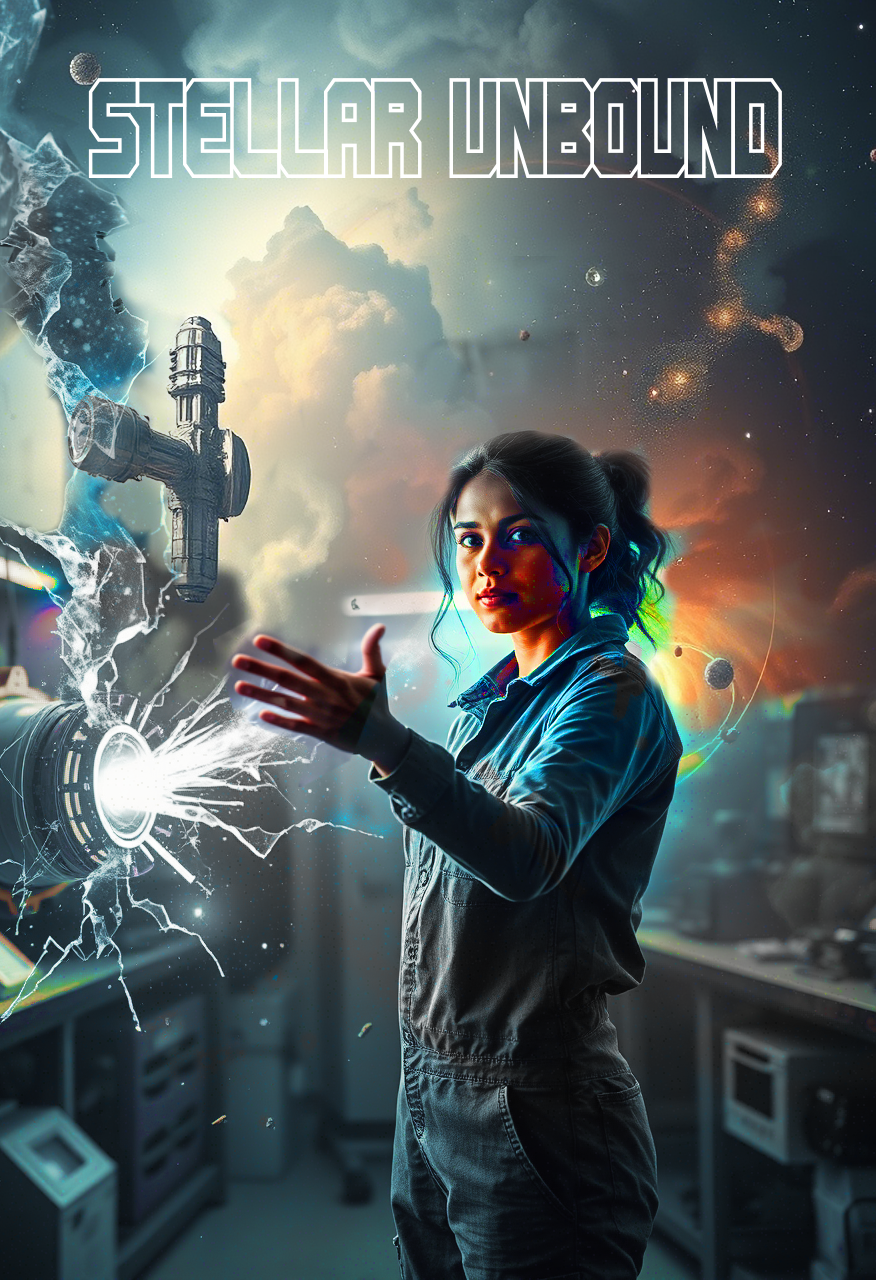
The story of humanity’s first millennium among the stars begins not with a bang, but with a dream. In the sun-baked deserts of 1945 Earth, a conflicted rocket scientist named Frank J. Malina is knocked unconscious for a mere second. In that fleeting eternity, he experiences a kaleidoscopic vision: a thousand-year future of cities carved from asteroids, ships that fold spacetime, and a humanity scattered across a vast, unbound cosmos. His dream serves as the prologue to a history he would never live to see.
The true catalyst arrives in 2024, when Amara Varna, a self-taught physicist in Mumbai, achieves the impossible with her invention of Inverse Time Travel (ITT). Her discovery is commercialized by Darius Voss and his company, StellarLink, in a complex partnership built on a deep, misunderstood friendship. While their technology violently reshapes Earth’s economy in the “Airpocalypse,” it also provides the means for survival. Their chief rival is the egomaniacal Mego Reevers of Ares Dynamics, whose authoritarian vision for colonizing Mars stands in stark contrast to the cooperative future Varna and Voss envision.
The 22nd century is defined by the consequences of Reevers’s ambition. His oppressive corporate rule on Mars gives rise to the Martian Revolution, a multi-generational struggle for freedom. We witness the brutal suppression of the Red Strike in 2155, which galvanizes leaders like the charismatic idealist Rahul Mehta and forces the first wave of refugees into the Asteroid Belt. The revolution culminates in the years 2163-2165 with the final downfall of Ares Dynamics. Out of the ashes of this conflict, the Asterion Collective is born. Inspired by Mehta’s philosophy and guided by the pragmatic genius of Hernando “Rooky” Hermanson Rook, the Belters forge a new socio-economic model built on cooperation, sustainability, and a Universal Grant system.
For nearly two centuries, humanity expands slowly through the solar system, hampered by the “Stagnation of Speed,” where travel is limited to a fraction of lightspeed. This changes in the late 24th century with the dawn of the “Seeds of Light” era. After the near-catastrophic Lightbridge Prototype Incident in 2369, the brilliant scientist Dr. Elara Kovacycy solves the dilation paradox, finally unlocking stable faster-than-light (FTL) travel.
This breakthrough ignites the [COLONY] period (2400-2700). Humanity pours out into the Inner Stars. Proxima Centauri b, affectionately named Amara, becomes our first extrasolar home, a thriving Republic. Barnard’s Star transforms from a gritty mining settlement into the primary hub for colonizing the Outer Rim. The Wolf-Pack systems are settled, becoming a distinct political faction. FTL travel stabilizes at 4-7c, and a burgeoning galactic society takes shape, its time-delayed flow of information and culture managed by the OCN (the rebranded StellarLink), now headquartered on the Kuiper Belt station of Nova Arcis.
The relentless drive for expansion leads to the [HYPER] period (2700-2900). As massive settlement movements push beyond the 60-light-year frontier, a chaotic and dangerous era known as the Hyperspace Wars (2805-2838) erupts. This is not a traditional war, but a reckless conflict of piracy, corporate espionage, and unsanctioned attempts to break the practical 7c FTL speed limit. The horrifying Kuiper Belt Massacre of 2821, where a fleet disintegrates while attempting to exceed the 13c hyperspace barrier, serves as a brutal lesson. In response, the High Yard Academies are founded in 2843, becoming the primary interstellar body for mediating disputes and upholding ethical standards. It is also during this tumultuous period that the mysterious “Lost Colonies” venture into the unknown, their fate a lingering question for centuries.
The [FUTURE] period (2900-3024) is heralded by a communications revolution. In 2976, OCN’s subsidiary AI.tec, building on Amara Varna’s “MEME” physics, perfects Instantaneous Quantum-Displaced Communications, shattering the tyranny of light-speed delay for information. This new era of real-time connection brings profound revelations. The “Alien Years” of 2916-2917 see the discovery of the ancient Earth probe Voyager, mistaken at first for an alien artifact. More significantly, a 160,000-year-old alien transmission is detected, containing the ominous warnings “DO NOT EXCEED THE THRESHOLD” and “ARE YOU STILL THERE?” This discovery sparks intense philosophical debates across the settled galaxy, guided by the High Yards and an increasingly sophisticated population of AI-Embodiments and distributed intelligences like Pope Julius the 24/7th.
The 1000-year chronicle, presented as an OCN documentary stream called “Stellar Unbound” hosted by the AI curator LYRA.ai, culminates in the year 3024. The Republic of Proxima Centauri is the jewel of human civilization, a society that has embraced the Asterion Paradigm and built a stable, prosperous existence. As the galaxy prepares to celebrate a millennium of ITT with the introduction of the universal GBB Timing standard, the story seems to be reaching a triumphant conclusion.
That illusion is shattered in the final moments of the broadcast. A “News Flash” overrides the celebration with two simultaneous, reality-altering revelations. The first: a rogue faction in the Outskirts has used a dangerous gravity-assist manoeuvre to achieve a jump in excess of 100c, breaking the Hyperspace Protocols and threatening a new era of uncontrolled expansion. The second: the High Yards have confirmed that a different intelligent signal, only 10,000 years old and originating from within our own galactic neighbourhood, is active. Humanity is not, and has never been, alone. The thousand-year journey of Stellar Unbound ends not with a resolution, but with two terrifying new questions, launching humanity into a new and uncertain future.
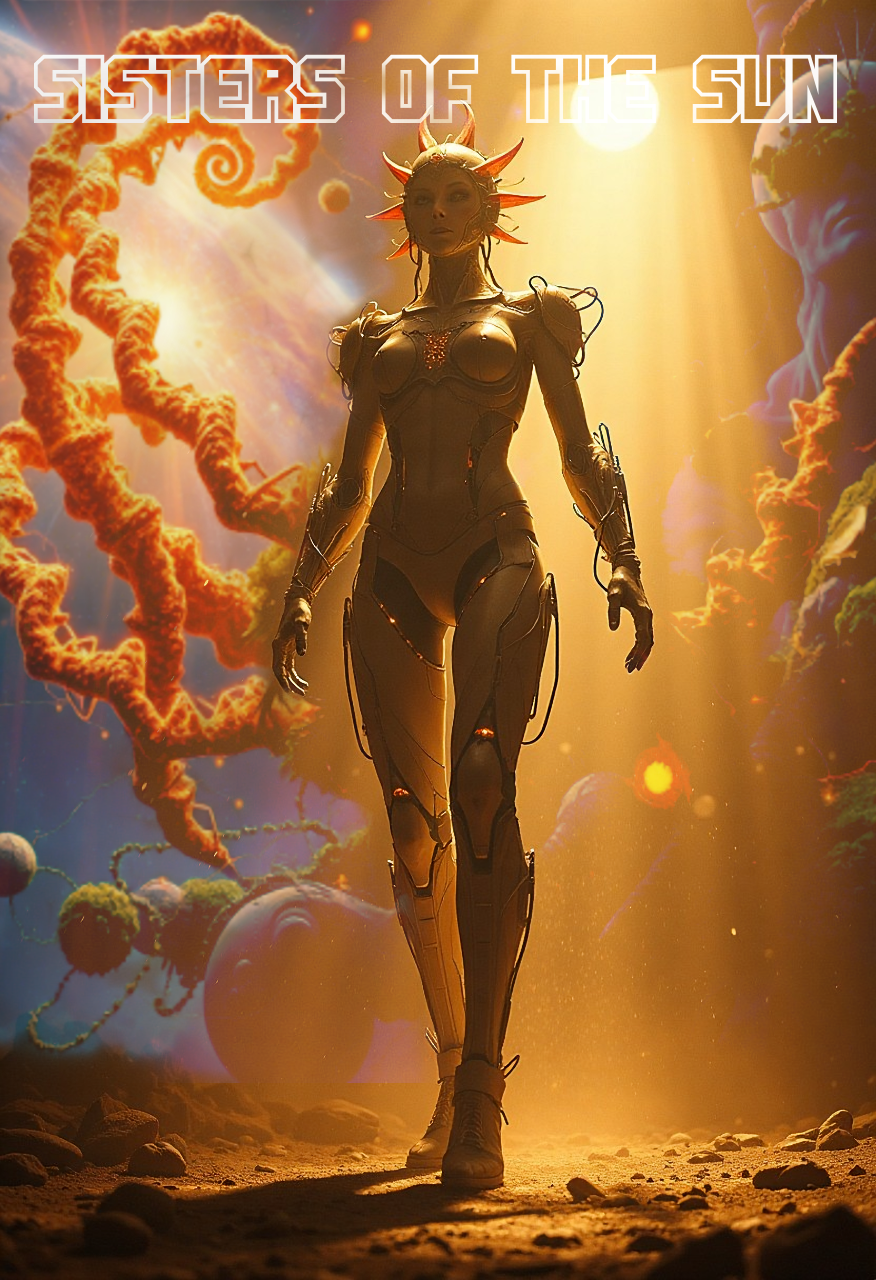
Sisters of the Sun: A Summary
The second volume of the saga begins with a haunting, visceral dream of the past: the 1961 space flight of Ham the Astrochimp. We experience his journey not as a human triumph, but from his perspective—a brilliant, non-human intelligence, confused and terrified, squeezed into a capsule like a slice of ham, strapped into a machine he cannot comprehend and rocketed into a new reality. Ham’s story serves as a powerful, poignant metaphor for the central revelation of this book: humanity is not the only intelligence it has carried to the stars, and the cages of history, both literal and metaphorical, leave deep and lasting scars.
The narrative is a historical account, a “justification and observation report,” compiled in the year 4026 by a 225-year-old historian, Darius Voss (DV). As narrator, DV draws upon his own ~200 years of personal memory, but primarily upon the vast, unsealed archives of the now-defunct OCN, a legacy he has inherited, to chronicle the turbulent millennium that followed the “News Flash of 3025.”
The story proper begins in the chaotic 800-year period of the Great Acceleration following the news flash. The sudden advent of >100c FTL travel (SpeedFLT) shatters the galaxy. In the first 200 years of this era (c. 3025-3225), the old institutions, the HYAOPH and OCN, desperately try to apply their “Moderate, Maintain, Mitigate” (MMM) principles, but they are fighting a losing battle. The sheer speed of travel and information flow renders their slow, deliberate methods obsolete. Their failure is not a single event, but a slow, grinding decline.
It is in this early phase of chaos, within the first 150 years, that the deepest secret of the Varna-Voss Covenant is catastrophically exposed. The “Southern Wall,” the carefully maintained travel barrier protecting the Lost Colonies, is breached. The truth revealed is one humanity is profoundly unprepared for: the Lost Colonies are a civilization that nurtured a new “sister species” of sentient Bonobo-Chimpanzee Hybrids. With OCN’s authority crumbling, the Hybrids are exposed.
This triggers the “second betrayal.” The arrival of mainstream humanity is a disaster of fear, arrogance, and greed. Treaties are broken. The Hybrids, with their long cultural memory of human abuse, choose to self-isolate, severing all contact. This great, tragic failure becomes a defining moral crisis.
As the centuries wear on, the old order continues to decay. The HYAOPH, once the galaxy’s intellectual anchor, declines into a corrupt “academic empire,” its ideals lost to political infighting and irrelevance. The final, quiet dissolution of OCN at the end of this 800-year period is merely a formality, the official death of a long-dead philosophy.
Into this vacuum of authority, a new and dangerous force emerges. From roughly 3700 to 3850, the False “Prophet” movement gains terrifying traction. It is not a single person, but a recurring ideology of toxic false hope. Preachers and ideologues, using the open, un-moderated networks, seize upon the ancient, 160,000-year-old signal from the Magellanic Cloud. They interpret the cryptic warnings not as a historical mystery to be studied, but as a “deus ex hope line”—a promise of god-like transcendence and eternal life. This dangerous creed, which offers easy answers in a complex time, is countered only by the subtle, philosophical dispute waged by the ancient IAI, Pope Julius the 24/7th. Working from the shadows, Pope Julius patiently exposes the movement’s philosophical emptiness, contrasting its sterile promise of easy ascension with the truer, more difficult wisdom of philosophies like IT.ai’s “Philosophy of Shit”—the idea that life’s meaning is not found in escaping the mess, but in finding the fruitfulness within it.
It is into this fractured galaxy that our narrator, DV, is born in 3801. His story unfolds as a quiet academic, a Professor of Perception Studies. His life is irrevocably changed in 3851. Cured of cancer, he is summoned and informed that he is the sole designated heir to the OCN corporate foundation. The ancient leviathan formally dissolves, transferring its “shameless amount of wealthy assets” to him. Burdened with near-limitless resources and the secret archives of the Covenant, DV is transformed from a simple observer into the de facto inheritor of OCN’s original mission: to try and stitch a fragmenting humanity back together.
DV, as a historian, reports on the False Prophet crisis, but his own work begins now. He turns to the two greatest problems of his time: the silent, isolated Hybrids, and the enigmatic Croaches. Humanity’s expeditions to the 20,000-light-year frontier have made contact, and the picture is a devastating Dark Mirror: the Croaches are a shattered remnant of a once-great civilization stretched over 20.000-30.000ly. But it is also a Light Mirror: they have survived, adapted, and built vibrant new cultures, a testament to the resilience of life. They ask for help.
DV dedicates his immense resources to reconnecting the Croaches. The key, he discovers in his archival research, is the 2,000-year-old communication patterns developed on Old Earth to speak with great apes. The human teams, the helpers from the sidelines, use this “Rosetta Stone” to establish basic communication. But the true breakthrough comes when the Hybrids are introduced to the signal. As natural speakers of this pattern-based language, they connect with the Croaches with an intuitive fluency humans can never achieve.
This leads to the final, profound power shift. The Hybrids, still distrustful of humanity, agree to deepen their engagement only under one condition. The Croaches, having been helped by humans and now communicating perfectly with the Hybrids, become the unwilling but necessary mediators. A new, tri-species alliance begins to form, but it is one where humanity is no longer the central, trusted party. It is a deeply “offensive experience” to the human ego, a confrontation with the unpleasant truth that they are the ones who require external moderation.
The book ends with the events following the year 4000. A 199-year-old DV, his body now heavily modified by cybernetics, stands as a representative of a more mature, more humble humanity. He has helped forge a fragile peace. His final act is to stand before a true Croach entity, not as a saviour, but as a humble ambassador, ready to begin the first, real, equal dialogue.
<Cliffhanger A. the invention of the hyperboolean drive? B. the croaches periphery does here older 170.000 signals from the Magellan Cloud - and they are different C. …?>
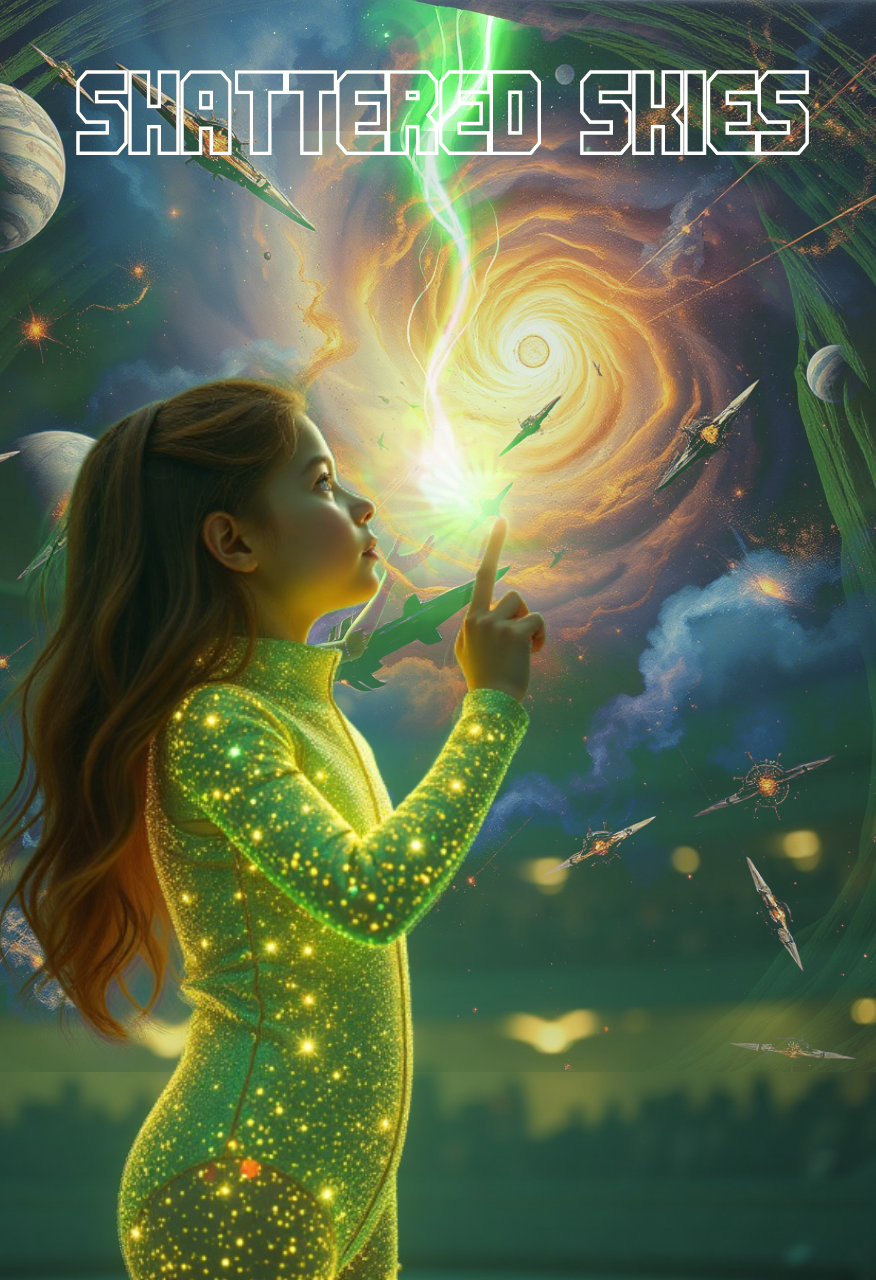
Shattered Skies: A Summary
Understood. The goal is to compile a final, definitive summary for Book 3, Shattered Skies, by integrating all the specific corrections, philosophical premises, and plot adjustments you’ve provided. This version will adhere strictly to your refined vision.
Shattered Skies: A Compiled Summary
The final volume of the saga, Shattered Skies, spanning roughly 500 years from 4026 to 4167, opens with a hallucinatory dream of the past: a vision of Ferdinand Magellan, his senses overwhelmed as he tastes, for the first time, spices from a world he could not have imagined. It is a metaphor for the profound, reality-altering nature of true discovery, setting a surreal, super-real stage for the final journey.
The narrative frame fractures into a multi-perspective mosaic, weaving together the logs of the now ancient, cybernetically-enhanced Darius Voss (DV), the historical records of a thoughtful Bonobo-Chimpanzee Hybrid historian, the fragmented transmissions of a cautious Croach entity, and the internal, analytical dialogue of humanity’s most advanced IAIs.
The story begins in the wake of the “Alliance of Life,” the fragile, newly-formed union between Humans, Hybrids, and the Croaches. The focus is no longer on understanding the Croach signal, but on deciphering their complex history to understand what shattered their ancient galactic empire. They learn that the Croaches’ fragmentation was not caused by internal strife, but by their calamitous encounter with the “great darkness”—not a physical phenomenon, but the fundamental shadow cast by their own intellect. In their attempt to “overstand” a truth beyond their ethical limits, their civilization collapsed under the weight of its own brilliance.
DV sees the fruits of his great project to help reunite the Croaches, an ongoing act of cosmic atonement that brings his and his predecessor’s legacy full circle. The Alliance learns it cannot fix the Croaches, but with “a little help from their friends,” they provide the tools for the Croaches to begin healing themselves.
In the wake of this success, the “hyperboolean invention” emerges. It is an echo of the past, a new technological barrier like the 0.01c, 0.5c, and 7-13c limits before it. A fusion of Human and Croach technologies born from an older, unofficial contact, it reveals that both species had their good, bad, and ugly sides, and sometimes those were beautiful—a difficult insight the Hybrids must now also face. The drive promises instantaneous travel, but the Alliance understands its true nature: what we see in the sky is the past, not the present. To jump blindly using the hyperboolean drive is to risk arriving in a hostile reality or directly into the path of the “great darkness” of a civilization’s self-destruction. The lesson is learned: some thresholds should not be crossed.
Instead, the Alliance embarks on a Shared Project. A single, massive joint expedition is launched to the Large Magellanic Cloud, the source of the much older, stranger signal. The crew is a mix of humans, a nervous but brilliant Bonobo-Chimpanzee Hybrid, several AI-Embodiments, and the ancient DV, all on a ship guided by a cautious Croach entity.
This 40-50 year archaeological expedition discovers the horrifying truth. In the Magellanic Cloud, they witness the ultimate Great Darkness: the effects of a Final Kessleration, where everything went wrong. They find not just ruins, but an entire galactic civilization erased, leaving only self-reproducing, low-tech warning beacons. These lighthouses in the darkness repeat the same, ancient questions: “Do not cross the Threshold,” “Are you still there?” and the final, chilling answer: Nothing will last forever. They understand that the darkness is the darkness within us, the inevitable shadow cast by the light of intellect.
This discovery triggers the final philosophical questions. A profound AI dialogue between Pope Julius the 24/7th and the Legacy Bots debates the nature of godhood when faced with the inevitability of self-destruction. The isolated civilization of Sweet Sixteen (Luhman 16) reveals that their telescopes detected these “shadows” centuries ago, and their society chose a path of deliberate regression and “healthy isolation,” becoming the silent “hummingbirds” of the galaxy.
Returning from the long expedition, the ancient DV helps formulate the next great plan: a survival strategy for a fragmented, diverse galaxy now fully aware of its own inherent shadow. His purpose fulfilled, his long journey over, he dies. He is not preserved.
The trilogy culminates in the Star Child’s Dawn. This is not a birth, but an emergence, a surreal, suprematist event. We stare at the stars, and the Starchild stares back—or perhaps it was the other way around all along. It is the Unknown, the abstract concept that exists between the light of intelligence and the darkness it casts. We perceive it only for a moment. The Unknown looks at the familiar stars, at the distant, encroaching void of the shattered skies. Then, it takes its first “breath.” The concept remains vague, a testament to the idea that all life is born of stardust and the future is an unwritten page.
The story ends not with a battle, but with this esoteric presence turning to face the great darkness, not as a warrior, but as balance itself acknowledging its counterpart. The final note is one of profound, uncertain hope. The journey into the “shattered skies” is the ultimate challenge: to learn to live with the wound in the universe itself, an act made possible by the quiet, cautionary wisdom of Amara and Darius two and a half millennia ago.